Best Non GamStop Casino UK 2026
Loading...
The house edge is the tax on every bet you place. It’s not hidden. It’s not a scam. It’s the business model. Every casino game ever built — from the roulette wheels of 18th-century Paris to the slots on your phone — is designed so that the operator retains a small mathematical advantage on every wager. That advantage, expressed as a percentage, is the house edge. It’s how casinos pay for servers, staff, licences, and the generous welcome bonus that brought you through the door.
Understanding the house edge doesn’t require a maths degree. It requires accepting one uncomfortable fact: over time, the casino wins. Not on every hand, not on every spin, and not necessarily during your session tonight. But across millions of transactions, the edge compounds relentlessly, converting player wagers into operator revenue with the certainty of a tide coming in. What the house edge tells you is the rate at which that happens — and knowing the rate lets you make informed decisions about which games to play, how much to wager, and how long to stay.
What House Edge Actually Means
The house edge is the percentage of each bet that the casino expects to retain over the long run. A game with a 2% house edge returns, on average, 98p for every £1 wagered. The remaining 2p is the casino’s gross margin on that game. The inverse of the house edge is the Return to Player (RTP): a 2% edge corresponds to a 98% RTP. The two numbers describe the same thing from opposite perspectives — RTP tells you what you keep; house edge tells you what the casino keeps.
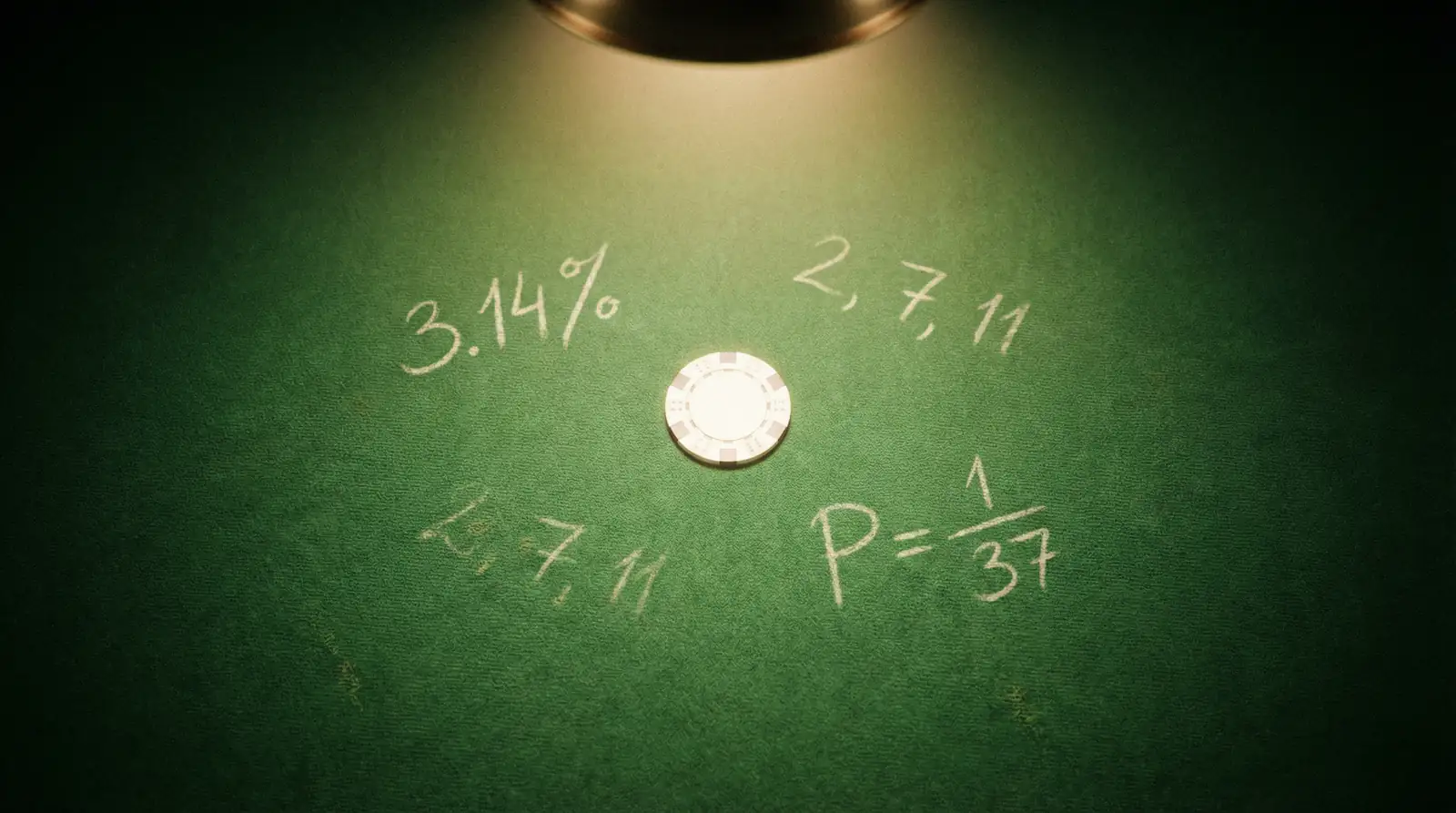
The formula is simple. For any bet with known probabilities and payouts, the house edge equals the difference between the true odds of winning and the payout odds. Take European roulette as the textbook example. A straight-up bet on a single number has a probability of 1 in 37 (there are 37 pockets on the wheel). The payout is 35 to 1. If the game were perfectly fair, the payout would be 36 to 1 — matching the 36 losing outcomes against your one winning outcome. The gap between 36:1 (fair) and 35:1 (actual) is the house edge: 1/37, or approximately 2.70%.
The critical nuance is the difference between long-run expectation and short-run reality. The house edge operates over an enormous sample size. In any single session, anything can happen. You might sit at a roulette table for an hour and walk away with twice your starting bankroll. The house edge didn’t stop working — variance (the natural randomness of outcomes) simply pushed your results to the favourable end of the distribution. Over 10,000 spins, the results will cluster tightly around the expected 2.70% loss. Over 100 spins, they’ll scatter widely. The house edge is a gravitational force: always present, always pulling, but only visible over distances long enough for the randomness to average out.
Variance is what makes gambling feel unpredictable — and what allows individual players to win in the short term despite facing a negative-expectation game. A high-volatility slot with a 4% house edge will produce sessions where you double your money and sessions where you lose everything. Both outcomes are consistent with the same house edge. The edge describes the average; your session is a single data point on a wide distribution. Confusing the average with your personal outcome is the most common mathematical error in gambling.
One more distinction: the house edge applies to the amount wagered, not the amount deposited. If you deposit £100 and wager it once on an even-money roulette bet, your expected loss is £2.70. If you deposit £100 and wager £10 per spin for a hundred spins (total wagered: £1,000), your expected loss is £27 — even though you only deposited £100. The total wagered amount, often called “turnover” or “handle,” is what the house edge operates on. Recycling your balance through multiple bets multiplies the effective cost.
House Edge by Casino Game Type
Blackjack offers the lowest house edge of any mainstream casino game when played with basic strategy: approximately 0.5% under standard European rules. That figure assumes the player makes the mathematically optimal decision on every hand — hitting, standing, doubling, and splitting according to the basic strategy chart. Without basic strategy, the effective house edge rises to 2% or more, depending on how many suboptimal decisions the player makes. Blackjack is the only common casino game where player decisions materially affect the house edge.
Baccarat provides the second-lowest edge among table games. The Banker bet carries a house edge of approximately 1.06% (after the standard 5% commission on Banker wins). The Player bet sits at 1.24%. The Tie bet — which pays 8:1 or 9:1 depending on the variant — carries an edge of roughly 14.4%, making it one of the worst wagers on any table in the casino. Baccarat’s appeal is simplicity combined with a low edge; there are no decisions to make beyond choosing which bet to place.
European roulette holds a house edge of 2.70% on every bet except those played under the La Partage or En Prison rules, which reduce even-money bets to 1.35%. American roulette, with its additional double-zero pocket, runs at 5.26%. The five-number bet on an American wheel (covering 0, 00, 1, 2, 3) reaches 7.89%, the highest edge on any standard roulette table.
Online slots span the widest range. Low-edge slots run at 2% to 3% (RTP of 97–98%), while high-edge slots can reach 8% to 12% (RTP of 88–92%). Progressive jackpot slots often sit at the high end of this range because a portion of each wager feeds the jackpot pool rather than being returned to the player. The UKGC requires all UK-licensed operators to display the RTP for every game, making it straightforward to compare the cost of one slot against another.
Live game shows — Crazy Time, Monopoly Live, Dream Catcher — carry house edges that vary by bet type, typically ranging from 3% to over 10% depending on the specific wager. The headline “big multiplier” bets tend to carry the highest edges, while simpler wagers on more frequent outcomes carry lower ones. The production values and entertainment factor of game shows are high, but the maths is less favourable than traditional table games.
Casino poker variants (Casino Hold’em, Three Card Poker, Caribbean Stud) generally sit between 2% and 5%, depending on the variant and the player’s decision quality. Side bets in these games routinely exceed 5% and can approach 10%.
Common Misconceptions About the House Edge
The most persistent misconception is that wins are “due” after a losing streak. This is the gambler’s fallacy, and it conflicts with how probability actually works. Each spin, hand, or game round is an independent event. The roulette wheel has no memory of previous outcomes. A run of ten reds doesn’t make black more likely on the eleventh spin — the probability remains 18/37, exactly as it was on the first spin. The house edge doesn’t accelerate or decelerate based on recent results. It applies uniformly to every wager, regardless of what preceded it.
A related misconception is that “hot” and “cold” streaks are real patterns rather than statistical noise. In any random sequence of sufficient length, clusters occur naturally. A run of six winning hands at blackjack is unremarkable in a 500-hand session — it’s well within the expected variance. Interpreting these clusters as evidence of a pattern, and then adjusting your bet size to “ride” or “counteract” the streak, is betting on an illusion. The house edge doesn’t recognise streaks; it recognises total wagers.
The belief that betting systems can overcome the house edge is mathematically refuted but emotionally persistent. Martingale, Fibonacci, D’Alembert, and every other progressive system rearrange the distribution of outcomes — they change how your wins and losses are sequenced — without altering the expected total loss. Over a given amount of total wagering, the expected loss is fixed: total wagered multiplied by house edge. No sequencing of bets can change that product.
Short-session illusions fuel another misconception: that the house edge “doesn’t apply” in brief sessions. In a sense, this is experientially true — variance dominates short sessions, so your outcome may diverge wildly from the expected value. But the edge still applies to each bet you place. Winning in a short session doesn’t mean you’ve beaten the edge; it means variance has temporarily overwhelmed it. The casino doesn’t need you to play long sessions. It needs enough players to collectively produce enough total wagering for the edge to manifest across the entire player pool.
Know the Cost Before You Sit Down
The house edge is not a moral judgment. It’s a price tag. Playing European roulette at £10 per spin costs you approximately 27p per spin in expectation. Playing a 96% RTP slot at £1 per spin costs you 4p per spin. Playing blackjack at £10 per hand with basic strategy costs you about 5p per hand. These are the per-unit prices of the entertainment you’re purchasing, and they vary by a factor of ten between the cheapest and most expensive games in a typical UK casino.
Knowing the cost doesn’t eliminate it. It eliminates the surprise. A player who understands that their £50 bankroll faces an expected loss of £2 at the blackjack table and £5 at the roulette table and £10 to £20 at the slots can make an informed choice about where to play. The game might still defy the expectation — variance works in both directions — but the decision was made with clear information rather than vague hope.
The house always has an edge. That’s the point. It’s the reason the casino exists, the reason the games are available, and the reason the lights are on. What you control is which games you choose, how much you wager, and how long you play. The house edge is the constant; your behaviour is the variable. Knowing the constant is the minimum standard for playing with your eyes open.