
 Available in GB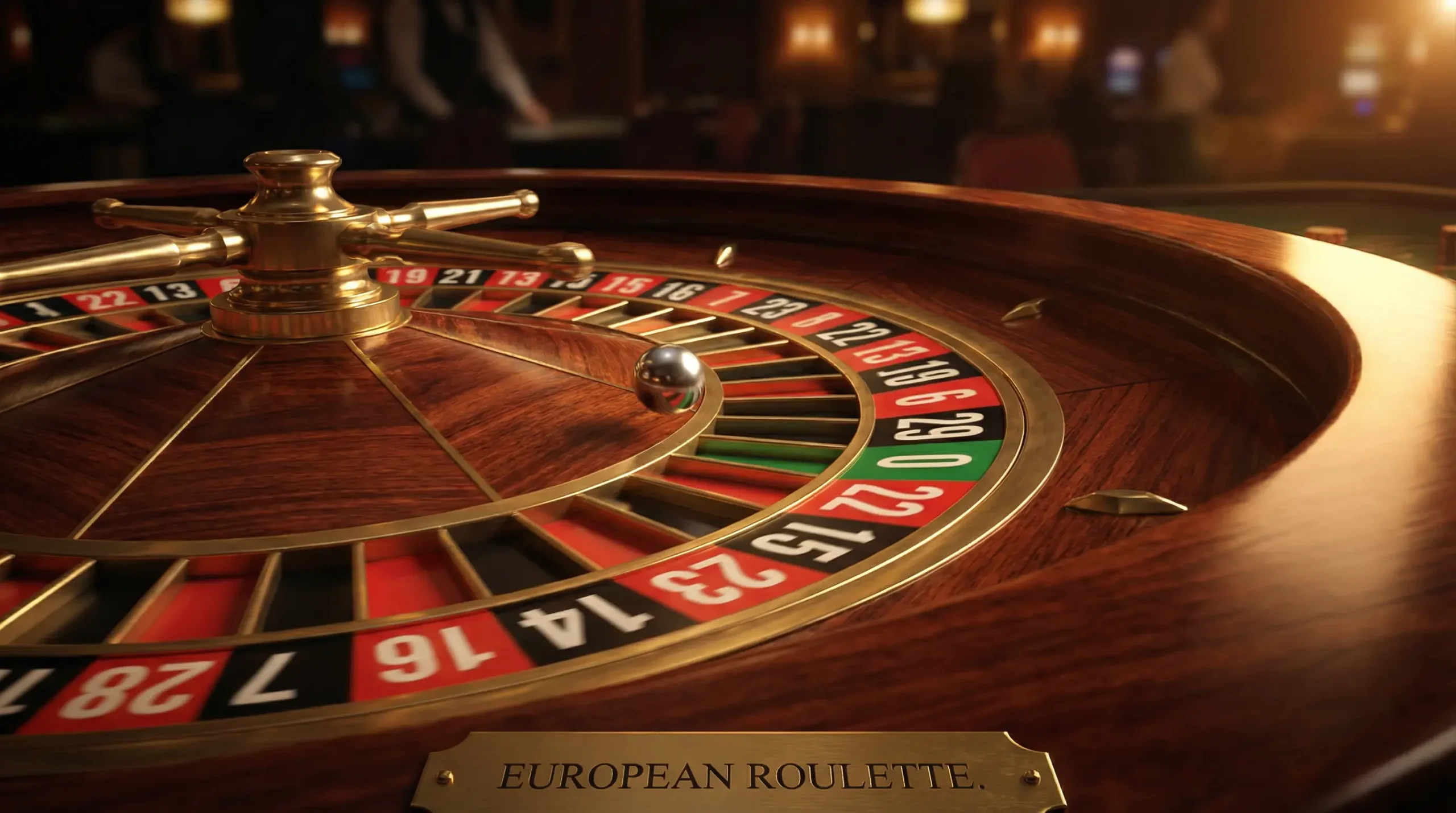
Roulette is the simplest casino game to understand and the most misunderstood in terms of probability. A ball drops onto a spinning wheel, lands in a numbered pocket, and either matches your bet or doesn’t. No decisions to make after the wager is placed. No strategy that changes the outcome. The simplicity is the product — and it’s also the trap, because the absence of complexity makes it easy to overlook how the maths actually works.
At UK online casinos, roulette is available in three main variants — European, American, and French — plus a growing library of live and enhanced versions that add multipliers, multiple balls, or game-show elements. The variants share the same basic mechanic but differ in ways that directly affect your expected losses. Choosing the wrong version of roulette costs you almost exactly twice as much per pound wagered as choosing the right one. That’s not hyperbole; it’s the arithmetic of one extra green pocket.
This guide covers the key differences between roulette variants, breaks down every standard bet type with its true probability and payout, and addresses the persistent question of whether betting systems can overcome the house edge. The answer to that last question has been settled by mathematics for over a century, but it bears repeating — especially when money is involved.
European vs American vs French Roulette
European roulette uses a wheel with 37 pockets: numbers 1 through 36, alternating red and black, plus a single green zero. The zero is the casino’s structural advantage. Every bet on the table pays out as though there were only 36 pockets, but there are 37. That discrepancy creates a house edge of 2.70% on every wager. Put differently, for every £100 you bet over time, you can expect to lose £2.70 on average. European roulette is the standard format at UK online casinos and the version you should default to whenever given a choice.
American roulette adds a second green pocket — the double zero (00) — bringing the total to 38. Payouts remain identical to European roulette: a straight-up number still pays 35:1, an even-money bet still pays 1:1. But the extra pocket means the house edge jumps to 5.26%. You’re playing the same game, receiving the same payouts, but losing at nearly twice the rate. The five-number bet — covering 0, 00, 1, 2, and 3 — is the single worst wager on any standard roulette table, carrying a house edge of 7.89%. American roulette exists at UK casinos because some players don’t know the difference, and some players don’t care. If you care, avoid it.
French roulette is played on the same single-zero wheel as European roulette, but it introduces two rules that further reduce the house edge on even-money bets: La Partage and En Prison. Under La Partage, if the ball lands on zero and you’ve placed an even-money wager (red/black, odd/even, high/low), you receive half your stake back immediately. Under En Prison, your even-money bet is “imprisoned” for the next spin — if your bet wins on the following spin, you get the full stake back; if it loses, the casino takes it. Both rules reduce the effective house edge on even-money bets to 1.35%, making French roulette the most favourable version of the game available at any UK casino.
Not all UK operators offer French roulette, and those that do sometimes limit it to their live casino sections. If you can find it, and you primarily place even-money bets, French roulette cuts your expected losses in half compared to standard European rules. That’s a material difference over any session longer than a few minutes.
The choice between these three variants is the single most impactful decision a roulette player can make. It has nothing to do with lucky numbers, bet patterns, or intuition. It’s a structural decision about which version of the game you sit down at, and it determines whether you’re paying a 1.35%, 2.70%, or 5.26% tax on every pound you wager. Everything else — the bets you choose, the system you follow, the feeling in your gut — is secondary to this.
Roulette Bet Types and Their True Odds
Roulette bets fall into two categories: inside bets, placed on the numbered grid itself, and outside bets, placed on the broader groupings around the perimeter of the layout. Every bet on a European roulette table carries the same 2.70% house edge — the payout is always calibrated to leave that margin in place. What changes between bet types is not your expected loss rate but the volatility of your session: how often you win, how much you win when you do, and how dramatically your balance fluctuates.
A straight-up bet covers a single number. On a European wheel with 37 pockets, the probability of hitting your number is 1 in 37, or approximately 2.70%. The payout is 35:1 — you receive 35 times your stake plus the original bet. If the game were perfectly fair, the payout would be 36:1 to match the 36 non-zero numbers. The gap between the true odds (36:1) and the payout (35:1) is the house edge at work. Straight-up bets are the highest-volatility option: you lose most of the time, but a single hit returns a large multiple of your wager.
A split bet covers two adjacent numbers on the layout. You place the chip on the line between them. The probability is 2 in 37 (5.41%), and the payout is 17:1. A street bet covers a row of three numbers — probability 3 in 37 (8.11%), payout 11:1. A corner bet covers four numbers meeting at an intersection — probability 4 in 37 (10.81%), payout 8:1. A six-line bet spans two adjacent rows of three, covering six numbers — probability 6 in 37 (16.22%), payout 5:1. Each of these inside bets covers more numbers than the last, offering a higher probability of winning at a proportionally lower payout. The house edge remains 2.70% throughout.
Outside bets cover the larger groupings. Even-money bets — red or black, odd or even, 1-18 (low) or 19-36 (high) — each cover 18 of the 37 numbers. The probability of winning is 18/37, or 48.65%. The payout is 1:1. These bets produce the smoothest sessions: you win roughly half the time, and the house edge manifests as a slow, steady erosion of your balance rather than dramatic swings. Dozens bets cover groups of twelve numbers (1-12, 13-24, 25-36) with a probability of 32.43% and a payout of 2:1. Column bets follow the same structure but group numbers vertically down the layout.
A common misconception is that outside bets are “safer” than inside bets. In terms of session volatility, this is true — you’ll see more frequent returns and smaller swings. In terms of expected loss per pound wagered, it’s false. Every bet on the table costs you 2.70% of the amount you stake, regardless of where you place your chips. A player who bets £10 on red for 100 spins and a player who bets £10 on number 17 for 100 spins will, over enough repetitions, lose the same average amount: £27. The experience will feel very different — one smooth, one chaotic — but the cost is identical.
Announced or call bets — Voisins du Zéro, Tiers du Cylindre, Orphelins — are combinations of inside bets grouped by the positions of numbers on the wheel rather than the layout. They’re common on French and European tables. Voisins du Zéro covers the 17 numbers nearest to zero on the wheel with a specific pattern of splits and corners. These bets don’t change the house edge; they simply offer a convenient way to cover a wheel section with a single wager. They add tactical variety for experienced players but confer no mathematical advantage.
Do Roulette Betting Systems Work?
The Martingale system tells you to double your bet after every loss, so that the first win recovers all previous losses plus one unit of profit. It works flawlessly in theory and catastrophically in practice. The problem is table limits and bankroll size. A run of ten consecutive losses on an even-money bet — which occurs roughly once in every 1,024 sequences — requires a bet of 1,024 units to continue the system. If your starting bet is £5, that’s £5,120 on a single spin, which exceeds the maximum bet at most UK online roulette tables. The system doesn’t fail because the maths is wrong; it fails because the maths requires infinite money and no table limits, neither of which exist.
The D’Alembert system is a gentler progression: increase your bet by one unit after a loss, decrease by one after a win. It avoids the exponential escalation of the Martingale, making it less likely to hit table limits in a short session. But the house edge still applies to every spin. Over time, the D’Alembert player loses at the same rate as anyone else — they just arrive at that loss via a smoother path. The system manages session volatility, not expected value.
The Fibonacci system follows the mathematical sequence (1, 1, 2, 3, 5, 8, 13…) for bet sizing after losses. Like the D’Alembert, it escalates more slowly than the Martingale and feels more sustainable during short sessions. Also like the D’Alembert, it does nothing to alter the 2.70% house edge. The wheel doesn’t adjust its probabilities based on your bet history, and the ball doesn’t compensate for previous results.
No betting system can overcome a negative-expectation game. This isn’t a matter of opinion; it’s a mathematical proof. If the house edge is 2.70%, then for every £1 wagered, the expected return is £0.973 regardless of how you sequence your bets. Systems can change the shape of your session — producing more frequent small wins at the cost of rarer large losses, or vice versa — but the area under the curve remains the same. The expected total loss over any given amount of total wagering is fixed by the house edge. Rearranging the order of your bets cannot change the sum.
The Wheel Doesn’t Remember Your Last Bet
The gambler’s fallacy — the belief that past outcomes influence future ones — is the most persistent error in casino gambling, and roulette is where it finds its most natural home. Red has come up seven times in a row, so black must be “due.” The ball has avoided the zero for fifty spins, so it’s “overdue.” The wheel must “correct” at some point. It must not. It will not. Each spin is statistically independent of every spin before it. The probability of red on the next spin is 18/37 whether the last ten results were red, black, or a perfect alternation of both.
Online roulette makes this fallacy easier to sustain than the live version, because most RNG tables display a history board showing the last twenty or thirty results. That board exists for entertainment. It has no predictive value. The patterns you see in it are the same patterns you’d see in any random sequence of sufficient length — clustering, streaks, and apparent trends that are artefacts of randomness, not signals within it.
If you play roulette at a UK online casino, the only decisions that materially affect your expected outcome are: which variant you play (European or French over American, always) and how much you wager in total across the session. Everything else — bet placement, system choice, lucky numbers — determines the texture of the experience without altering its cost. That cost is 2.70% of everything you bet, collected invisibly, one spin at a time.
There is nothing wrong with enjoying roulette for what it is: a clean, uncomplicated game of chance with transparent odds and a modest house edge, provided you’re playing the right variant. The mistake is believing you can outsmart a mechanism that has no intelligence to outwit. The wheel doesn’t remember your last bet. It doesn’t know you’re at the table. And the sooner you accept that, the more honestly you can decide whether the price of playing is one you’re willing to pay.
Visit casinoonlinerealmoneyuk for comprehensive UK real money casino reviews and guides.
Meet the top Casino Game Providers behind UK casino titles.