
 Available in GB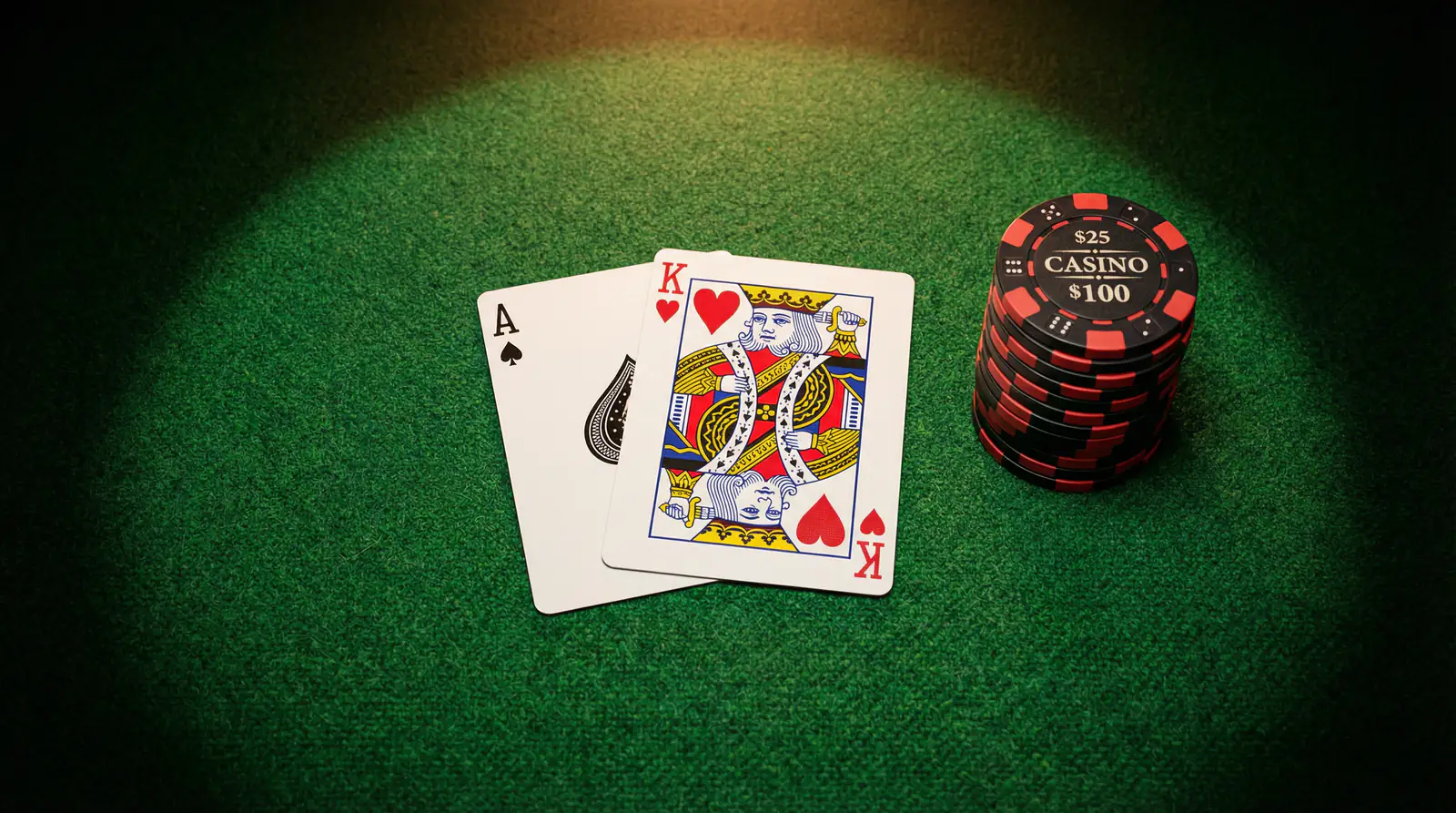
Blackjack is the only mainstream casino game where your decisions directly affect the house edge — and in the UK, you can play variants with an edge below 0.5%. That figure isn’t theoretical. It’s the mathematically optimal outcome when a player follows basic strategy perfectly against standard European rules. No other casino game available at UK-licensed operators offers that combination of player agency and low house advantage.
The game’s appeal rests on a structural tension that slots and roulette can’t replicate. In every hand, you face a decision: hit, stand, double down, or split. Each choice has a correct answer based on the dealer’s visible card and your hand total. Make the right decisions consistently and the house edge compresses to its minimum. Make the wrong ones — standing on 16 against a dealer’s 7, doubling on soft 18 against a 9 — and you’re volunteering extra margin to the casino with every hand.
This guide covers the standard rules you’ll encounter at UK online casinos, explains how basic strategy works in practice rather than theory, and reviews the most common blackjack variants across RNG and live formats. Whether you’re approaching the game for the first time or recalibrating after playing casually for years, the mechanics here are worth understanding before you place your next bet.
Blackjack Rules for UK Online Casinos
The core objective of blackjack is to beat the dealer’s hand without exceeding a total of 21. Number cards (2 through 10) carry their face value. Jacks, queens, and kings are each worth 10. Aces count as either 1 or 11, depending on which value benefits the hand — a hand containing an ace valued at 11 is called a “soft” hand because it can absorb another card without busting.
At the start of each round, you receive two cards face up. The dealer receives one card face up (the “upcard”) and one face down (the “hole card”), though in most European-rules variants common at UK online casinos, the dealer takes only one card initially and draws the second after all players have acted. This distinction matters: in the American format, the dealer checks for blackjack before players act, potentially ending the hand early. In the European format, players complete all decisions before the dealer reveals the second card, meaning you can lose a doubled or split bet to a dealer blackjack that hadn’t been checked.
Your options after receiving your initial two cards are as follows. Hit means requesting an additional card. You can hit as many times as you like, provided your total doesn’t exceed 21. Stand means you keep your current total and pass the action to the dealer. Double down means you place an additional bet equal to your original wager and receive exactly one more card — no further hitting is allowed. This is the decision that matters most in blackjack strategy, because it’s the primary mechanism for increasing your bet when the odds favour you. Split is available when your two initial cards share the same value: you divide them into two separate hands, each with its own bet equal to the original. Some variants allow resplitting; most limit it to one split per pair.
The dealer plays according to fixed rules with no discretion. In most UK-facing blackjack games, the dealer must hit on any total of 16 or below and stand on 17 or above. Some variants specify that the dealer hits on soft 17 (a hand totalling 17 with an ace counted as 11), which increases the house edge slightly — roughly 0.2% — because the dealer has an additional chance to improve a middling hand.
Blackjack — a two-card hand totalling exactly 21 — pays 3:2 at most UK casinos, meaning a £10 bet returns £25. This is the standard payout and the one you should insist on. Some operators, particularly in their RNG games, offer 6:5 blackjack instead, which pays only £22 on that same £10 bet. The difference sounds small; over hundreds of hands it is not. A 6:5 payout increases the house edge by approximately 1.4%, which transforms blackjack from one of the best games in the casino to one of the worst. Check the pay table before you sit down.
Side bets — Perfect Pairs, 21+3, Insurance — are available at most UK online blackjack tables. Each carries a house edge substantially higher than the main game, often between 3% and 8% depending on the specific bet and the number of decks in play. Insurance, offered when the dealer’s upcard is an ace, is a bet that the dealer has blackjack. It pays 2:1, but the probability of the dealer having a 10-value hole card is less than one in three, making it a negative-expectation wager in virtually all circumstances. Basic strategy says: decline insurance. Every time.
Basic Strategy — Reducing the House Edge
Basic strategy is a mathematically derived set of decisions that tells you the optimal play for every possible combination of your hand and the dealer’s upcard. It was first computed in the 1950s and has been refined using computer simulations running billions of hands. The strategy is not a system for winning — it’s a system for minimising losses. The house retains an edge even when you play perfectly. What basic strategy does is reduce that edge to its theoretical minimum, typically between 0.4% and 0.6% depending on the specific rules in play.
The strategy is typically presented as a chart or table. One axis lists your hand total (or specific card combination); the other lists the dealer’s upcard. The intersection tells you whether to hit, stand, double, or split. For example: you hold a hard 11 (no ace, or an ace forced to count as 1) and the dealer shows a 6. Basic strategy says double down. The logic: 11 is a strong starting total with no bust risk from a single additional card, and the dealer’s 6 is one of their weakest upcards — they’re likely to draw to 16 and then bust. By doubling, you’re increasing your bet at a moment when the probabilities favour you.
Another key scenario: you hold a hard 16 and the dealer shows a 10. This is the most uncomfortable hand in blackjack, and it’s where many players deviate from strategy. The correct play is to hit. Yes, you’ll bust roughly 62% of the time. But standing on 16 against a dealer’s 10 loses even more often, because the dealer is likely to make 17 or better. Hitting gives you a slim chance of improvement; standing gives you almost none. Basic strategy doesn’t promise that the correct play will work on any given hand — it promises that over thousands of hands, the correct play loses less than the incorrect one.
Soft hands — those containing an ace counted as 11 — require their own decision set. A soft 17 (ace plus 6), for instance, should always be hit, because you can’t bust and any card from 2 through 4 improves the hand. A soft 18 (ace plus 7) is trickier: basic strategy says to stand against dealer upcards of 2, 7, and 8, double against 3 through 6, and hit against 9, 10, or ace. The logic varies by scenario, but the principle is consistent — maximise expected value on every decision.
Splitting pairs follows a similar logic matrix. Always split aces and eights. Never split tens or fives. Split twos and threes against dealer upcards of 2 through 7. The reasoning behind these rules is purely mathematical: splitting aces gives you two chances to hit 21, while splitting tens breaks up a strong 20 for no good reason. These rules are not intuitions or habits — they’re the output of probability calculations that have been tested across billions of simulated hands.
The challenge for online blackjack players is not learning the strategy — charts are freely available and most are simple enough to memorise with a few hours of practice. The challenge is following it consistently. When you’re sitting on 16 and the dealer shows a 7, the temptation to stand and hope the dealer busts is powerful. But hope is not strategy. Basic strategy works precisely because it removes hope from the equation and replaces it with arithmetic.
Popular Blackjack Variants at UK Casinos
Classic Blackjack — the standard six-deck or eight-deck game with 3:2 payouts and dealer stands on all 17s — is the baseline against which every variant should be measured. At UK online casinos, the RNG version of Classic Blackjack typically carries an RTP of 99.5% or higher when played with perfect basic strategy. This is the game you want if your goal is to minimise the house edge and play mathematically clean blackjack.
European Blackjack restricts doubling to hard totals of 9, 10, and 11 only, and uses the no-hole-card rule described earlier. These restrictions increase the house edge slightly — around 0.1% to 0.2% compared to the more permissive American rules. It’s a small difference, but over a long session it accumulates. European Blackjack is common at UK RNG tables and is the default ruleset at many live dealer tables.
Lightning Blackjack, offered in Evolution’s live casino lobby, adds random multipliers to winning hands. Before each round, random card values are assigned multipliers of up to 25x. If your winning hand contains a multiplied card, your payout is enhanced. The catch — and there is always a catch — is that Lightning Blackjack applies a fee on every bet, effectively increasing the base house edge to fund the multiplier pool. The game’s RTP comes in below standard blackjack, typically around 99.56% according to the provider’s published figures, though the variance is significantly higher.
Infinite Blackjack, also from Evolution, removes the seven-player seat limit by dealing the same initial hand to all players. Individual decisions diverge after the deal, and four optional side bets are available. The house edge on the main game remains competitive, but the side bets carry edges of 3% to 8%, and the format’s design subtly encourages their use. Playing Infinite Blackjack without side bets is perfectly valid and keeps your edge close to standard.
Single-deck blackjack variants appear occasionally at UK casinos and offer the lowest theoretical house edge of any format — around 0.15% with optimal play. However, operators compensate by adjusting rules: reducing the blackjack payout to 6:5, restricting splits, or prohibiting doubling after a split. Read the rules carefully. A single-deck game with 6:5 blackjack is worse than a six-deck game with 3:2. The number of decks matters less than the payout structure.
Strategy Won’t Beat the House — But It Gets You Close
Mastering basic strategy is the minimum competence level for playing blackjack seriously. It won’t make you a long-term winner — no legal strategy can, because the house edge exists by design and card counting is ineffective against the shuffled or continuously dealt shoes used by online casinos. What basic strategy does is establish the floor: the lowest possible cost per hand for the entertainment of playing.
That floor is remarkably low compared to other casino games. A blackjack player using basic strategy faces a house edge of roughly 0.5%. A roulette player faces 2.70%. A slot player faces anywhere from 3% to 12%. In pound terms, if you wager £1,000 over a session of blackjack with perfect strategy, your expected loss is about £5. The same £1,000 wagered on European roulette costs you £27 in expectation. On a typical online slot, it costs you £40 to £60. Blackjack is not free money; it is cheap entertainment, relatively speaking.
The discipline required to maintain basic strategy over hundreds of hands is where most players fail. Deviation is tempting — standing on soft 18 when you should double, hitting a pair of 8s instead of splitting, taking insurance because the dealer “looks” like they have blackjack. Every deviation from the chart adds a fraction to the house edge. Over a session, those fractions compound. The casino doesn’t need you to make catastrophic errors. It needs you to make small ones, consistently.
If you’re going to play blackjack at a UK online casino, learn basic strategy before you deposit. Use a chart until the decisions become automatic. Ignore side bets unless you consciously accept their higher house edge as the price of variety. And always check the payout on blackjack — if it’s 6:5 instead of 3:2, find a different table. The game rewards precision, punishes sloppiness, and respects anyone willing to do the homework. In a casino full of games designed to feel like luck, blackjack is the one that lets skill narrow the gap.
Visit casinoonlinerealmoneyuk for comprehensive UK real money casino reviews and guides.
Play with real dealers in our Live Casino section.