
 Available in GB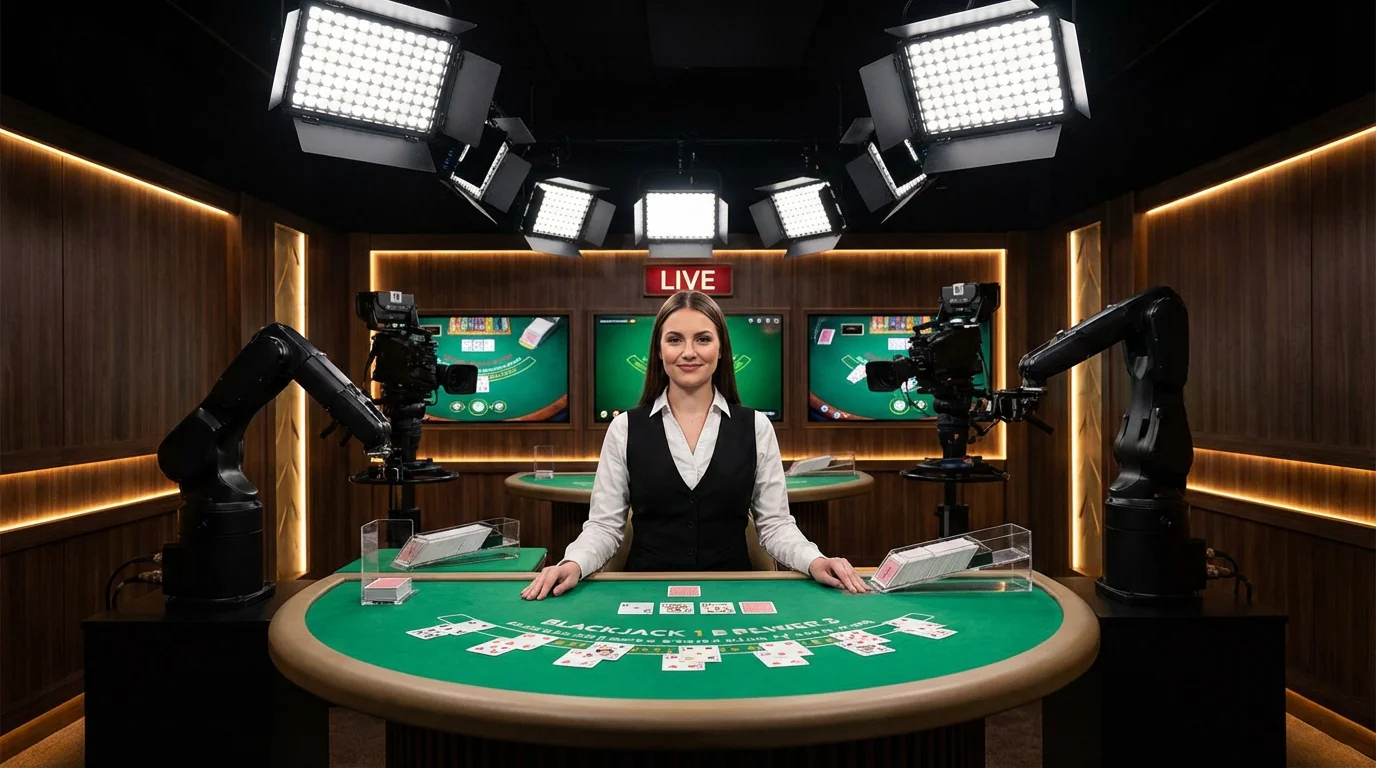
Live casino bridges the gap between clicking a screen and sitting at a real table — streamed in HD from studios built specifically for the camera. The dealer is a person, the cards are physical, and the roulette wheel has actual weight and momentum. What happens on screen is happening in real time, in a controlled studio environment, with the results captured by cameras and relayed to your device through a betting interface overlay.
For UK players, live casino has become one of the fastest-growing segments of the online gambling market. The format appeals to players who find software-driven games too abstract but who don’t want the commitment (or travel) of visiting a physical casino. It sits in a middle ground that didn’t exist a decade ago, and the technology behind it has matured to the point where the viewing experience rivals broadcast television in quality.
This guide explains how live casino technology actually works, covers the main game types available at UK-licensed operators, and addresses the common question of whether live dealer games offer any material advantage over their software-generated counterparts. The short answer to that last question is more nuanced than most players expect — which is exactly why it’s worth exploring.
How Live Casino Technology Works
Live casino games are streamed from purpose-built studios operated by specialist providers. The three dominant names in the UK market are Evolution, Pragmatic Play Live, and Playtech. Evolution operates studios in Latvia, Malta, Georgia, and several other locations; Pragmatic Play runs facilities in Romania and elsewhere; Playtech maintains studios across Europe and Asia. These aren’t converted conference rooms — they’re broadcast-grade production environments with multiple camera angles, professional lighting, and soundproofing designed to support dozens of simultaneous tables running around the clock.
Each table is staffed by a trained dealer who manages the physical game — shuffling and dealing cards, spinning the roulette wheel, or operating the game show wheel. The dealer’s actions are captured by multiple high-definition cameras, including overhead shots for card games and close-up angles for the roulette ball’s landing position. The cameras feed into encoding hardware that compresses the video stream and transmits it to the casino operator’s platform, which in turn delivers it to your browser or mobile app.
The critical technology that makes live casino function as an online gambling product is optical character recognition, commonly abbreviated as OCR. Small cameras positioned above the card shoe or dealing area read the value and suit of each card as it’s dealt. OCR converts the physical card into digital data — the seven of spades becomes a data point that the software can process. This digital conversion allows the betting interface to update in real time: your screen shows the card dealt, updates your hand total, calculates payout options, and settles bets automatically. Without OCR, you’d be watching a video feed with no interactive layer — essentially a CCTV feed of someone playing cards.
Latency — the delay between the dealer’s physical action and what you see on screen — is the engineering challenge that separates good live casino from bad live casino. The best providers achieve latency under two seconds, which is imperceptible for most game types. Roulette, where the ball’s resting position determines the outcome, is particularly sensitive to stream quality. If the video freezes during the spin, the bet still settles based on the actual outcome, but the player experience suffers. UK-licensed operators are required to ensure that game outcomes are determined by the physical action, not the video feed — meaning a connection dropout doesn’t void your bet or change the result.
The betting interface overlays the video stream and handles all player interactions: placing chips, selecting bet types, confirming decisions in blackjack (hit, stand, double, split), and managing side bets. Chat functionality lets you communicate with the dealer and, in some games, with other players at the table. The interface is the same regardless of whether you’re on desktop or mobile, though layout proportions adjust for screen size. Most providers now design mobile-first, given that the majority of UK live casino sessions happen on phones.
Behind the scenes, every hand, spin, and game round is logged by the provider’s back-end systems and audited for compliance with UKGC technical standards. The Gambling Commission requires that live casino results are verifiable and that the physical game is conducted according to published rules. Providers submit regular audit reports to maintain their licences, and the digital logs provide a complete record of every outcome should a dispute arise.
Live Casino Game Types Available in the UK
Live blackjack remains the most-played live table game at UK casinos. The standard format seats seven players at a virtual table, each playing their own hand against the dealer. Bet-behind options allow additional players to wager on a seated player’s hand when all seats are occupied. Most UK operators offer tables with minimum bets starting from £1 to £5 and maximums stretching into the thousands. House edge on standard live blackjack — assuming European rules with the dealer standing on soft 17 — sits around 0.5% for players using basic strategy. That’s materially lower than any slot and comparable to the best RNG blackjack variants.
Infinite Blackjack, pioneered by Evolution, removes the seat limit entirely. Every player receives the same initial two cards, but individual decisions (hit, stand, double, split) diverge from there. The format solves the capacity problem — no waiting for a seat — while preserving the core decision-making element that makes blackjack appealing. Side bets like “Any Pair” and “Hot 3” carry significantly higher house edges than the main game, sometimes exceeding 5%, which is worth knowing before you tick those boxes automatically.
Live roulette is the second pillar of the UK live casino market. European roulette tables with a single zero dominate, maintaining the 2.70% house edge that has defined the game for centuries. Lightning Roulette, another Evolution creation, adds random multipliers of up to 500x to selected straight-up numbers each round. The trade-off is that standard straight-up payouts are reduced from 35:1 to 29:1 to fund those multipliers, which raises the effective house edge slightly for players who spread their bets across the board. It’s an entertaining variant, but the maths is marginally worse than standard European roulette — a detail the flashy presentation doesn’t go out of its way to communicate.
Live baccarat serves a smaller but dedicated UK audience. The game’s simplicity — bet on Player, Banker, or Tie — translates cleanly to the live format. Banker bets carry a house edge of approximately 1.06% (minus the standard 5% commission), making baccarat one of the lowest-edge games in the live casino. Speed Baccarat condenses the dealing time for players who prefer a faster pace, while various squeeze variants add theatrical tension by slowly revealing cards.
Game shows represent the fastest-growing category in UK live casino. These are hybrid products that combine elements of live presentation, random number generation, and interactive betting mechanics. Crazy Time, the headline game show from Evolution, features a large spinning wheel with four bonus rounds, multiplier overlays, and a presenter whose energy levels are calibrated for maximum engagement. Dream Catcher, Monopoly Live, and Deal or No Deal Live follow similar principles with different themes. The house edges on game show products vary widely depending on the bet type — some wagers carry edges above 5% — but the entertainment value is high, and the format attracts players who might never sit down at a traditional blackjack table.
Live poker variants round out the selection. Casino Hold’em, Three Card Poker, and Caribbean Stud are the most common, all played against the dealer rather than against other players. These games combine an element of decision-making with fixed house edges, making them appealing to players who want more interaction than roulette offers but less strategic depth than a full poker game.
Live Dealer vs RNG — Which Is Better?
The question of whether live dealer games are “better” than RNG-powered equivalents depends entirely on what you mean by better. If better means a lower house edge, the answer is: sometimes. Live blackjack with standard rules often matches or improves on the best RNG blackjack offerings, partly because the physical game mechanics enforce standard dealing procedures. Live European roulette carries the same 2.70% house edge as its RNG counterpart. There’s no inherent mathematical advantage to either format when the rules are identical.
If better means trust, live casino does offer a psychological advantage. Watching a physical card leave a physical shoe feels more verifiable than trusting a random number generator you can’t see. This perception is worth acknowledging even though it’s technically irrelevant — both formats are audited, both are regulated, and both produce outcomes consistent with their stated odds. The RNG used in software-driven games is tested by independent labs and certified by the UKGC. It’s no less fair than a physical deck. But humans are visual creatures, and the ability to watch the process unfold provides a layer of reassurance that numbers on a screen don’t.
If better means speed, RNG wins decisively. A software-driven blackjack hand takes seconds. A live blackjack hand takes a minute or more, accounting for dealing, player decisions across the table, and settlement. For players who want maximum hands per hour, RNG is more efficient. For players who want the social texture of a real dealer, the slower pace is a feature, not a flaw.
Table minimums tend to be higher in live casino than in RNG games. Running a live studio with professional dealers, cameras, and encoding hardware costs more than hosting a software-driven game on a server. That cost is passed to the player through higher minimum bets — typically £1 to £5 at the low end, compared to £0.10 or £0.20 in RNG games. If you’re working with a small bankroll, RNG games give you more spins or hands for the same money.
The Dealer Is Real — Your Edge Is Still Mathematical
The dealer is a real person. The cards are real objects. The wheel has physical mass and the ball bounces unpredictably across its frets. All of this is true, and none of it changes the mathematics. European roulette in a live studio carries the same 2.70% house edge as European roulette generated by an algorithm. Live blackjack rewards basic strategy in exactly the same way its software counterpart does. The format changes the delivery mechanism; it doesn’t alter the underlying product.
What live casino does change is the experience of losing. When a dealer sweeps your chips off a physical felt, or when the ball lands one pocket away from your number on a real wheel, the emotional register is different from watching an animation resolve on a screen. That heightened realism cuts both ways. Wins feel more tangible, which is enjoyable. Losses feel more personal, which can make responsible bankroll management harder if you’re not paying attention to your session totals.
The UKGC’s responsible gambling requirements apply identically to live casino and RNG games. Deposit limits, loss limits, session timers, and reality check prompts function the same way regardless of format. The presence of a human dealer doesn’t exempt the operator from any compliance obligation, and it doesn’t exempt you from the basic discipline of setting limits before you sit down.
Live casino is, at its best, a genuine technical achievement — the closest approximation of a land-based casino experience available to someone sitting on their sofa. The production quality from the top providers is exceptional, the game integrity is sound, and the variety keeps expanding. Just remember that the camera angles, the studio lighting, and the dealer’s professional charm are all part of the presentation layer. Underneath it, the house edge is doing exactly what it always does, one hand at a time.
Visit casinoonlinerealmoneyuk for comprehensive UK real money casino reviews and guides.
Start small with our list of Minimum Deposit Casinos.